A full paver replacement in Fort Myers or Cape Coral isn't a small number. Depending on the size of the driveway or pool deck and the material chosen, you're looking at $8,000 to $20,000 or more — sometimes significantly more. It's one of the larger discretionary home expenses a homeowner can face.
What surprises many homeowners is how rarely that expense is actually necessary. Sunken pavers, rocking pavers, faded color, weed-filled joints — these are maintenance problems, not structural failures. Almost all of them can be corrected without pulling up a single paver that doesn't need to come up.
Sunken and Uneven Pavers — Fixable Without Replacement
Individual pavers sink for a handful of reasons: base erosion from years of heavy rain, root pressure from nearby trees, poor initial compaction in one section, or simply time and load. None of these scenarios require tearing out the whole surface.
The repair process is more straightforward than most people expect. You pull the affected pavers — which, because of how they're installed, lift out cleanly without disturbing the surrounding ones. You re-level the base, replace the bedding sand, set the pavers back, re-sand the joints, and compact the area. Done correctly, it looks factory-new. There's no visual seam, no obvious repair, no evidence anything was ever wrong.
The key is addressing sinking pavers before they compound. A paver that's dropped a half-inch is a quick fix. One that's been sitting sunken for years in an area with poor drainage may have eroded the base enough that a larger repair is warranted — but still far less expensive than full replacement.
When Should You Actually Replace?
There are situations where replacement is the right answer. It's worth knowing what they are, so you're not talked into a full tear-out when it isn't needed — or discouraged from one when it actually is.
Replacement makes sense when:
- Pavers are physically cracked, shattered, or structurally damaged beyond re-leveling
- There's an underlying drainage problem that has caused the same area to sink repeatedly — until drainage is corrected, any repair is temporary
- The entire base across a large area has failed, meaning re-leveling isolated sections won't hold
- The pavers themselves are a discontinued style and matching replacements aren't available
These cases are the minority. The more common scenario is isolated settling in one or two areas, with the rest of the surface in good shape — and that's squarely in restoration territory.
Faded Pavers — Tinting vs. Replacing
Color fading is the complaint we hear most often from homeowners who are otherwise happy with their pavers. Florida's UV exposure is relentless — even high-quality concrete and clay pavers lose their original richness within a few years without protection. What started as a warm terracotta or rich charcoal becomes a washed-out, flat gray that makes the whole property look tired.
Replacing pavers to fix faded color is like repainting a house by tearing down the walls. Tinting addresses the problem directly, at a fraction of the cost.
Here's how tinting works in practice: the tint is a concentrated colorant that's diluted to your desired intensity before application. A light dilution gives a subtle enhancement — essentially bringing the existing color back to life. A stronger mix creates a more dramatic shift, allowing you to change the hue significantly if you want a different look entirely. The tint is applied to clean, dry pavers before the sealer coat goes on. It bonds into the sealer layer and becomes a permanent part of the finish — not a surface coating that wears off independently.
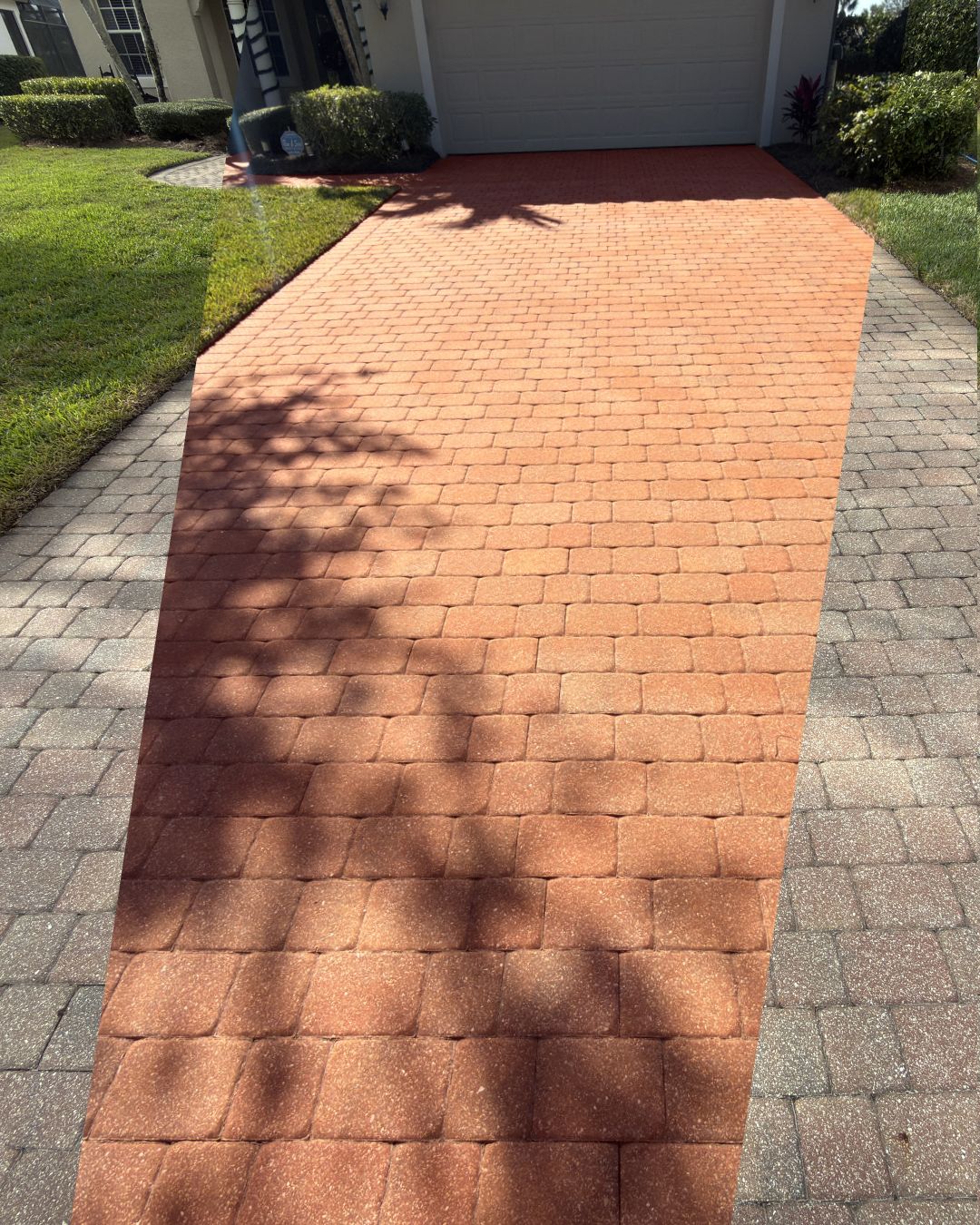
The result can be genuinely stunning. We've done tinting jobs where homeowners walked out to see the finished product and didn't recognize their own driveway — in a good way. The color is deep, even, and rich in a way that new pavers often aren't, because new pavers are still bright and raw before they've settled into their surroundings.
What Colors Can You Achieve?
The range is wide. Common choices for Florida homes include:
- Earthy tans and warm beiges — classic, neutral, works with most exterior palettes
- Warm terracottas and burnt oranges — traditional Florida look, makes a pool deck feel like a resort
- Deep charcoals — modern, dramatic, looks sharp with white or gray exteriors
- Rich chocolate browns — warm and premium-looking, popular for driveways
- Slate grays — cooler and contemporary, ages well
The tint is mixed to your specifications, so you're not choosing from a handful of preset options. It's worth looking at physical samples in your actual lighting conditions before committing — colors shift significantly between indoor lighting and direct Florida sun. We can bring samples to the property so you can see exactly what you're getting before any product is mixed.
We've transformed driveways that homeowners thought were beyond saving. If you're unsure whether yours is a restore or replace situation, send us a photo — we'll give you an honest assessment. No commitment, no sales pitch. 239-307-2929.
The Full Restoration Process
A complete paver restoration follows a specific sequence, and the order matters. Skipping or rushing any step produces a result that won't hold up.
- Thorough cleaning. The surface gets pressure washed — not just a rinse, but a proper clean with a surface cleaner that removes algae, organic matter, staining, and any old sealer that's failing. The joints get cleaned out as well. This is the step most DIY jobs underestimate.
- Re-leveling sunken sections. Any pavers that have settled get pulled, the base is corrected, and they're reset flush with the surrounding surface.
- Re-sanding joints. Polymeric sand or standard joint sand is swept into the joints, compacted, and leveled. This is what stabilizes the entire surface and prevents future weed intrusion.
- Tinting (if desired). The colorant is applied to the clean, dry surface and allowed to penetrate before the sealer goes on top.
- Sealing. A professional-grade sealer — we use URE Seal H2O almost exclusively — is applied in the correct dilution and coat thickness. The surface is left to cure.
The end result: pavers that look better than they have in years, protected from UV, rain, staining, and joint erosion for the next 3–5 years. Learn more about the sealer we use and why it matters →
Restoration Isn't Always the Answer — But It's Almost Always Worth Exploring First
We want to be straightforward about this: sometimes replacement really is the right call. We'll tell you when that's the case, and we won't try to talk a homeowner into a restoration job that won't hold. There's no value in doing work twice.
But in our experience, the majority of homeowners who come to us assuming they need full replacement end up with a restoration that exceeds their expectations — and keeps several thousand dollars in their pocket. The conversation is always worth having before you start pulling up pavers.
Send us a photo, give us a call, or request a free quote and we'll come take a look. We'll tell you exactly what we see and what we'd recommend.